 Patent Continuation
What the output actually looks like
A complete run against a public specification, captured on 2026-08-18 and printed here unedited. Ten claims drafted, and the tool's own critique flagged all ten: you start from the problems, not a blank page.
This is one run, on one model, against one small public specification. Re-running the same command produces different claims, because the drafter is a language model.
Two of the ten drafted claims, and what its critique said
Shown in full, exactly as produced. The critique runs against the same specification and reports what it cannot find support for.
Ten drafted, ten flagged, and that is the point
Every claim this run produced was flagged by the same tool that drafted it. The second claim above recites “the valve body” without introducing it; the third restates the parent rather than pursuing different scope. Ordinary drafting defects, found before you spend time on them, which is the work this tool does.
The input
The first claim of the parent, as filed, from the committed walkthrough fixture:
One command supplies both the specification and the parent claims, so it needs no files of your own:
What produced this
This model sits in the middle of the measured range; the benchmark shows how the others compare. To run it yourself, see choosing a model for your machine or the download.
What it looks like on a real application
The desktop app on a granted public application, its specification and allowed claims from the USPTO's data, and its Patent Center file history attached. Every state below is one the app produced; nothing was arranged by hand.
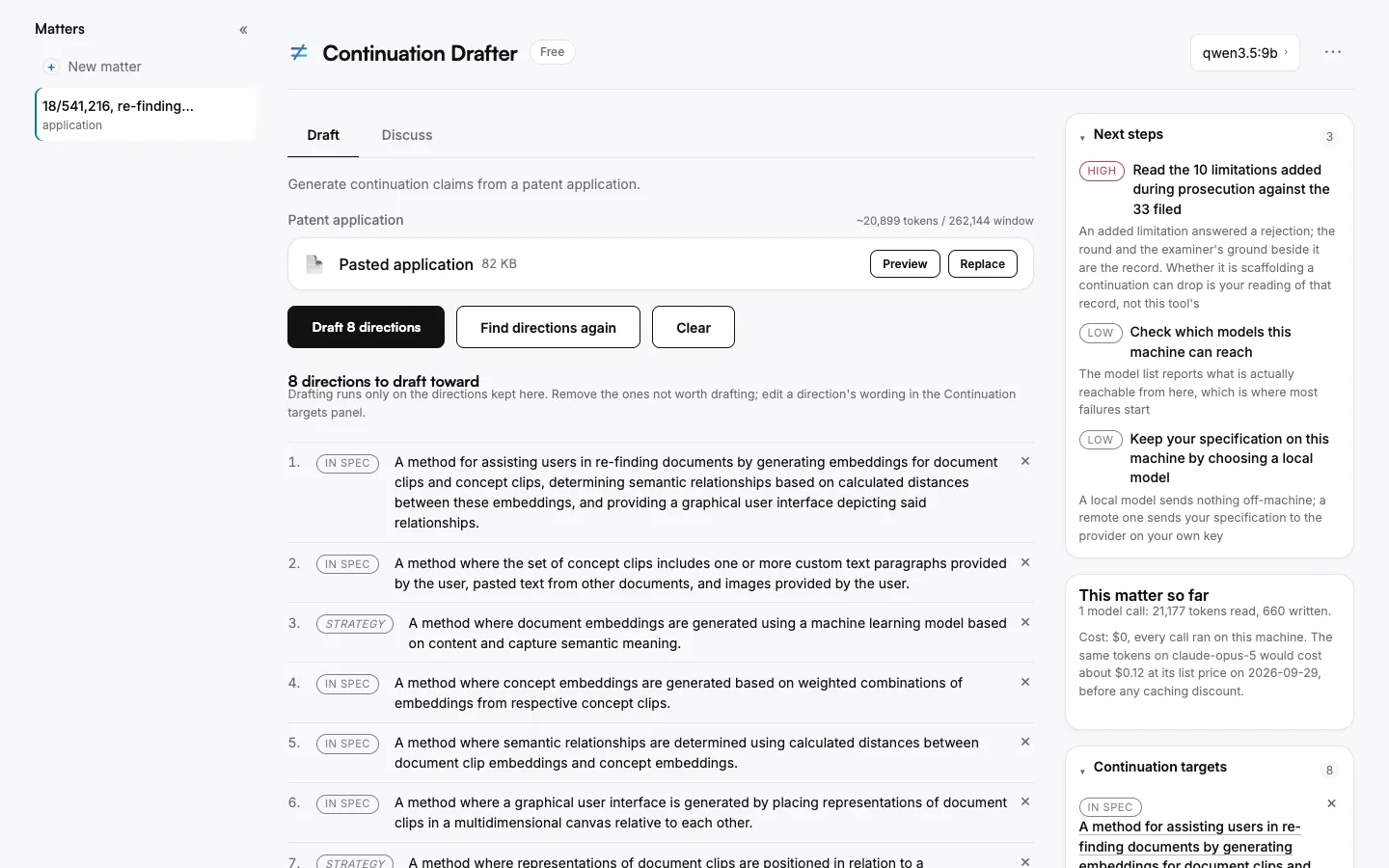
First, the directions, before anything is drafted
Each direction is marked as found in the specification or as a drafting strategy. You remove the ones not worth drafting, and only the ones you keep are drafted.
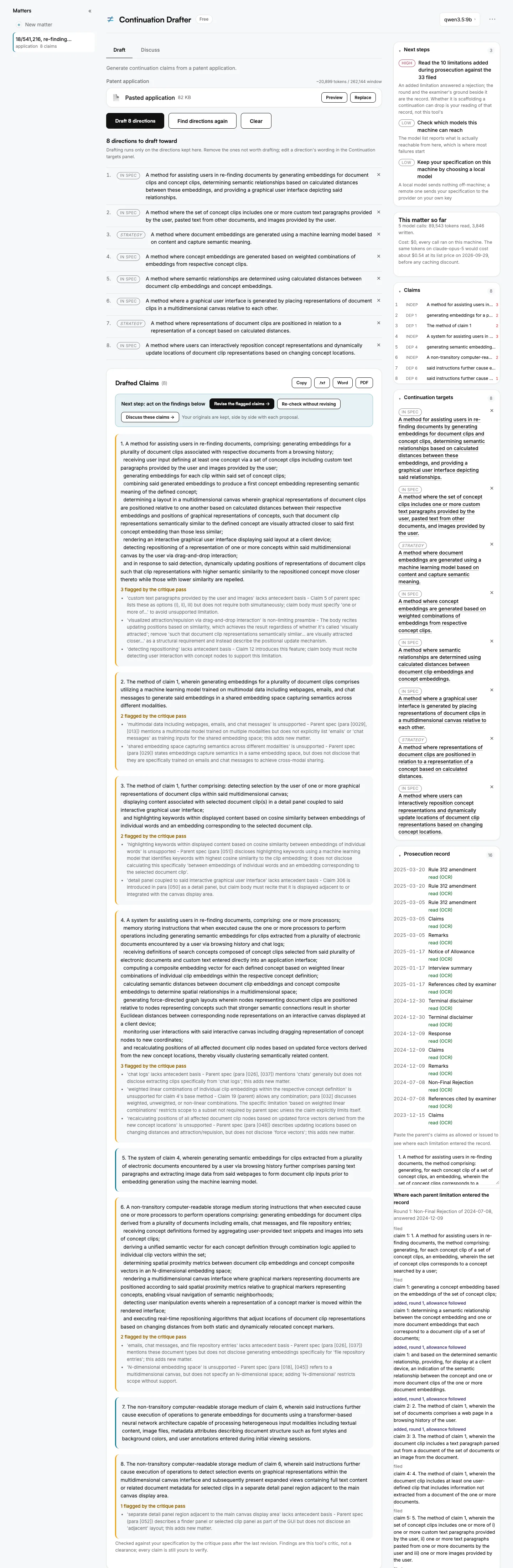
Then the drafted claims, with what the tool flagged in each
The whole page after drafting: the claims with the defects the tool's own critique pass raised under each, and beside them the cost of the matter so far, the claim list, the directions, and the papers it read from the file history. Scroll inside the picture to see all of it.
What it reads from a file history
The record reader over the Non-Final Rejection and the Notice of Allowance of
application 18/541,216, a public, granted Patent Center file, captured on
2026-09-30 on qwen3.5:9b running locally and printed
here unedited.
Every quotation is checked against the paper's text. Verified means the words are in the paper as quoted; not verified means they are not (usually a quotation shortened with an ellipsis, or a misread scan), so you know exactly which ones to check. It reports what the paper says, never whether a rejection was right or an amendment needed.
The rejections, as the reader reported them
| Claims | Ground | References | Quotation |
|---|---|---|---|
| 19-20 | 35 U.S.C. 101 | none | Claims 19-20 are rejected under 35 USC 101 because the claimed invention is directed to non-statutory subject matter... The specification is silent to limit that such medium exclude signals. Therefore covers transitory propagating signal per se (non-statutory subject matter). See In re Nuijten... (not verified) |
| 1-12 and 19-20 | nonstatutory double patenting | U.S. Patent No. 11,847,178 | Claims 1-12 and 19-20 are rejected on the ground of nonstatutory double patenting as being unpatentable over the claims 1-12 and 19-20 of prior U.S. Patent No. 11,847,178... they are not patentably distinct from each other because they are directed to substantially the same invention. (not verified) |
| 13-18 | statutory double patenting | U.S. Patent No. 11,847,178 | Claims 13-18 are rejected under 35 U.S.C. 101 as claiming the same invention as that of claims 13-18 of prior U.S. Patent No. 11,847,178. (verified) |
The examiner's reasons for allowance
Verified against the paper. The limitations the reasons credit, quoted by the reader:
Verified.
Verified.
Not verified: compare with the paper.
How well the reader does across more papers was measured, on this file and one other.